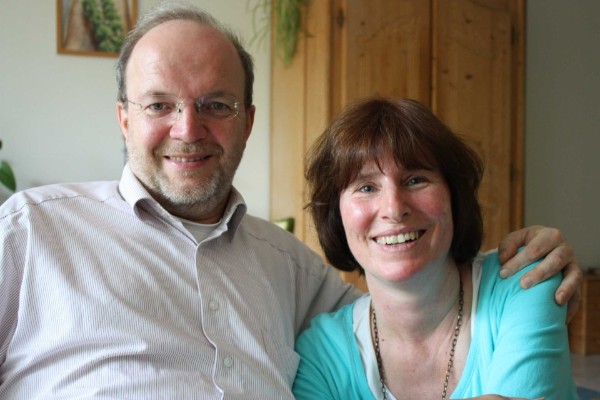
Hi, my name is Gerd Prengel.      Gerd and Evi     I am 44  years old, and I live with my wife and 2 children close to Darmstadt, Germany (family photo galery). Since my teenage years, music has meant so much to me. First of all I love classical music. My heroes are Mozart, Beethoven and Schubert. I also wrote a good number of midi pop songs. In the area of pop music by far my favourite is Bruce Springsteen. Important to me are the quality of the melodies, the depth and variety of emotional expression and the passion and transcedence which the music conveys.

My desire to write music begin at an age of 17 - in the time I began to sense how God is a wonderful reality as I
began to open up to Him. Many times when I communicate with Him I feel like there's music boiling within me which just needs to be released
in the form of new melodies, songs or symphonic movements... Music and God

In this site I am happy to present to you some of the music which I have written in classical style:

I. Stringquartett in C Major based on sketches by L.v.Beethoven

      Beethoven                    premiere
       Beethoven writing my favourite music,                   After the first performance of my stringquartett (Febr. 2001)
        the Missa solemnis (1823)

This quartett is based on the last sketches Beethoven wrote shortly before his death around November 1826 for his planned stringquintett in C Major! I made use of  his completed wonderful introduction and the beautiful main themes of all 4 movements. The MP3 were recorded by the use of Merlin soundfonts.

1. Andante maestoso/Allegro                                     Download MP3 (9,6 MB)   (download with right mouse click)

Introduction
The introduction is almost completely by Beethoven. I just arranged it for a string quartet since it is just available in a piano arrangement by Diabelli (WoO62). I like this introduction very much. It reminds me of the wonderfully majestic and melodious introduction to Beethoven's overture op.115.
The Allegro starts with flowing eighth notes in a way similar to the quartet op.59,1 with the main theme calmly performed by the cello. From 2:27 I use another wonderful and jubilent sketched theme from Beethoven's quintett:

quartett12
In the development the main theme is elaborated only in minor - firstly in a calm and melancholic way and then with counterpoints and also conflicting ways. The Coda begins with a solemn slow variation of the main theme and ends with a furious stretta.                    

2. Andante cantabile con variazioni                            Download MP3 (9,6 MB)

Andante
An Andante with 10 variations on Beethoven's 9/8 Andante theme in G Major which reminds us of the Mozart-like Andante theme in 6/8 from the first Symphony op. 21 or the Andante from op. 18,6. I feel it is very suited for variations, especially those in minor I love very much.  

3. Scherzo Presto                                                        Download MP3 (4,7 MB)

Scherzo
A furious Presto in c-minor based on Beethoven's 8 bar motif with equal 1/4 notes in the violins answered by the knocking fate motif in the bass. The Trio has a contrasting calm and melodic character.

4. Allegro vivacce                                                       Download MP3 (8,5 MB)

Allegro vicacce

I tried to elaborate Beethoven's theme (which reminds us of the Rondo from op.130) in several ways: with humorous parts, longer melodious cantabile parts and conflicting fugatos in the development. The Coda has two parts: a slow expressive variation of the main theme in c minor and a furious Presto.

II. Symphony c-minor, 3 movements on sketches for Beethoven's Tenth symphony
 
In the years 1825 and 1825 Beethoven made several sketches for a 10th symphony. I wrote 3 symphonic movements making use of the main theme sketches. Based on the basic line of the sketches for the main themeof the first movement I built an own main theme for my Allegro, the sketched theme for the second movement I used for the Andante theme of my slow movement (see detailed explanations).

1. Andante /Allegro con brio ed appassionato      Download MP3 (13,5 MB)   (download with right mouse click)

2. Adagio cantabile / Andante                               Download MP3 (12,5 MB)                               

3. Scherzo Allegro con brio                                   Download MP3 (6,0 MB)


III. Adagio religioso for Stringquartett  - Fantasia on the theme B-A-C-H      Download MP3 (6,6 MB)

B-A-C-H
This is a very meditative Adagio in g minor for a stringquartett on the famous 4-note pattern B-A-C-H, on which also Beethoven in the year 1825 tried to compose a overture.
The atmosphere  here is of deep sadness and pain. A contrasting second theme in Eb Major, a kind of  choral, rises up from this like a solemn prayer conveying the love of God. Both parts are repeated but with even more intensity of expression.

IV. Symphonic Choral                                                                                        Download MP3  (5,7 MB)

A solemn choral theme is introduced by the celli and then gradually overtaken by the other strings and finally by the whole orchestra. This is followed by a fugato. The movement ends jubilantly resuming the choral theme from the beginning.

V. Schubert: Fragmentary Andante for a 10th symphony in D, D936a            Download MP3 (10,4 MB)

Franz Schubert       Schubert 936

This is, as far as I know, a MP3 world premiere in the internet: A fragmentary Andante in b minor for a 10th symphony sketched by Schubert in the last weeks of his life. This movement has a depth of expression which is unsurpassed!!! From the piano sketch I realised without adding any new notes a rough orchestra version.  There is a wonderful CD recording of the whole symphony available with a realisation by Prof. Newbould, England, but I don't  find his instrumentation of this movement so fitting. I prefer the instrumentation by Prof. Gülke.  

VI. Sketches on the Ninth symphony by L.v. Beethoven (1st movement)  Download Midi (28 KB)

By listening to this midi you con follow how maybe the most ingenious symphonic movement ever written came into being - step by step from most simple attemps to the work we know today (further explanations). I am grateful to Mrs. Altmann for being so kind to send me the outstanding dissertation by Mrs. Jenny Kallick on this subject which made this unique midifile possible.


Pictures 

Pictures related to Beethoven from a trip to Vienna

I'd be happy to hear from you ....  Email Contact